

To develop sustainable procurement within their company, procurement departments have several tools at their disposal. One of the key approaches is to adopt a circular economy model, which involves reducing environmental impact throughout the product life cycle, right up to end-of-life through collection and take-back solutions. The objective: reduce pressure on resources and waste production. Such an approach can be applied to many product categories, starting with office furniture.
The benefits of such an approach
Businesses that organise the take-back of their office furniture at end-of-life have everything to gain. They strengthen their CSR strategy, save money, ensure compliance and enhance their brand image.
Contributing to the CSR strategy
The take-back of office furniture at end-of-life is part of any CSR (Corporate Social Responsibility) strategy. As Pierre-Emmanuel Saint-Esprit, Circular Economy Director of the Manutan Group, reminds us: "80% of a product's impact on the environment and biodiversity occurs during the production and extraction phases of resources. To limit their overall footprint, companies must therefore find new ways to produce and consume." This approach thus helps to reduce pressure on resources as well as carbon footprint. Moreover, there is a social dimension. These services help to create local jobs and strengthen territorial anchoring, and sometimes even promote professional integration.
Reducing costs
Collection and revalorisation services for office furniture represent a real opportunity for savings for the company. This reduces costs related to landfill as well as logistics costs and, in some cases, the company even goes so far as to make profits from buying back office furniture that still has value.
Ensuring compliance
Companies are required to manage the end-of-life of their professional furniture, like all their waste. In European countries, this obligation is materialised in particular through Directive 2008/98/EC of the European Parliament. This requires following a hierarchy of treatment methods, in order to favour the most sustainable office solutions.
Enhancing brand image
Lastly, the company can also promote the approach to its stakeholders: employees, customers, partners, investors. By displaying measurable results, the company demonstrates that it translates its commitments into tangible actions. In a context where extra-financial criteria are increasingly scrutinised, this is a differentiating asset.
What steps to map out furniture?
To prepare for the collection and take-back of office furniture, it is important to take stock. This allows you to know the nature, condition and value of your office furniture, and above all to identify the most appropriate solutions for their end-of-life.
Listing the furniture
The first step consists of identifying the type of professional furniture and the volume it represents.
Assessing its condition and value
Next, it is important to determine whether these desks are still functional, aesthetically acceptable, whether they need to be cleaned and/or repaired to have a second life, or whether they are simply out of use. For pieces that remain on the market, it is necessary to determine whether they have potential for resale.
Choosing the channel
From this information, several options are possible to extend the usage life: reuse, donation, resale or recycling. This will be decided according to the volume, but also the condition, materials and quality of the furniture. After which, the collection phase can begin.
How to organise your collection efficiently?
An efficient collection solution requires a good dose of anticipation and coordination. Everything happens again in four stages: planning, selecting, organising and documenting the operation.
Planning the take-back
The first step is to define a schedule for the operation. It can be planned at the start of a move or at the end of a refurbishment. Some organisations integrate it into the construction of their framework agreements. This is part of their requirements: when delivering new office furniture, the supplier must systematically take back the old elements to give them a second life.
Organising the logistics
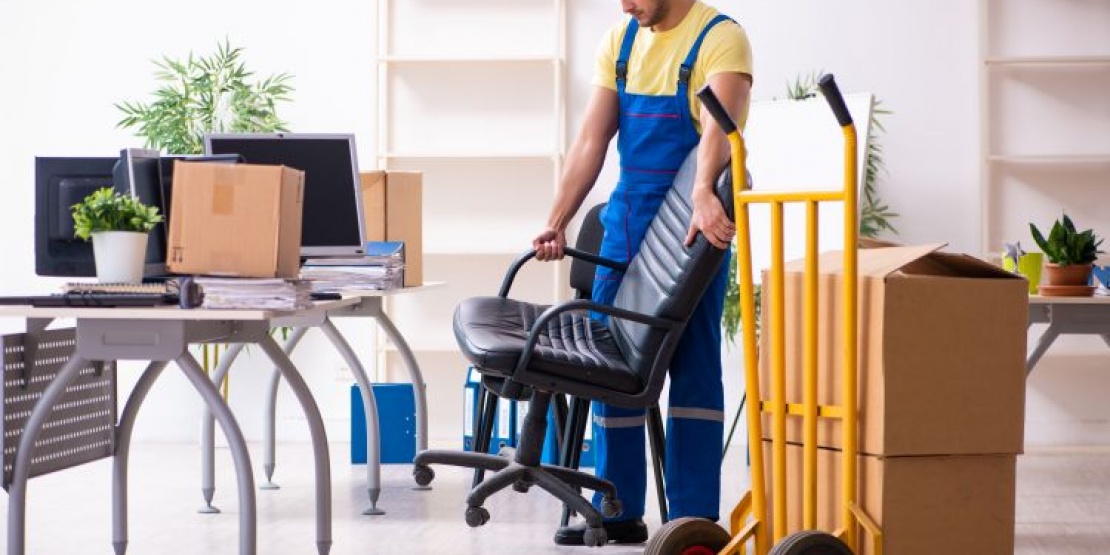
The logistics part must not be neglected. It is necessary to organise to move and store the elements, possibly dismantle them, all whilst pooling resources. This involves paying attention to on-site constraints, whether in terms of storage space or access to proceed with removal, for example.
Selecting your partner
Companies have every interest in calling upon third parties to entrust them with their used office furniture. They will turn to eco-organisations that ensure collection and recycling, associations that promote reuse or their own suppliers or distributors who offer a turnkey solution.
Documenting the operation
To promote the approach, it is important to collect all associated documents: donation certificates or recycling certificates, for example. Ideally, these contain quantified data on the positive impact of the operation, such as the quantity of CO2 emissions avoided, the volume of materials saved, etc.
The solutions offered by Manutan
Within the Manutan Group, a European leader in BtoB e-commerce, we are developing a range of circular economy services to support companies and local authorities. Among them is a bespoke solution for the collection and take-back of office or workshop furniture.
This covers all types of professional furniture: office chairs, executive chairs, office desks, cupboards, pedestals, executive desks, meeting tables, chairs, stools... Everything takes place within our own Circular Hub, in a priority neighbourhood in the town of Le Bourget, France.
Our teams take care of everything: collection, stock inventory, quotes, revalorisation... Depending on the condition, our experts guarantee the best second life for your equipment: the purchase of office furniture and its resale, donation or recycling in an environmentally friendly manner. If we offer you the best options, you remain the decision-maker.
At the end, we provide you with a CSR report of the operation, specifying the CO2 emissions saved and the professional integration hours funded by you. We have thus become the first player in the sector to offer a 100% integrated collection and refurbishment service for company furniture.