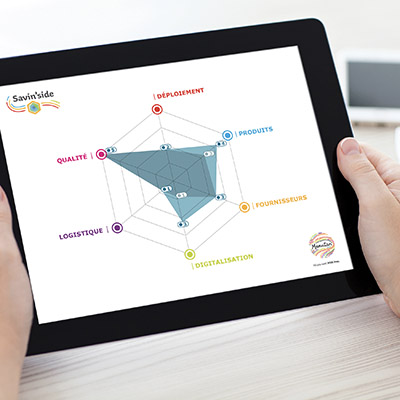



SROI (Social Return on Investment) is an evaluation method that enables organisations to measure and monetise the social, societal and environmental impacts of an action or investment, in order to compare the value created for society with the resources engaged. It is gradually becoming established as a strategic tool: it helps to objectify supplier choices, manage ambitious CSR commitments and demonstrate the real contribution of sustainable procurement policies. Many organisations today are seeking to understand how to integrate this method into their practices in order to better value the social impact generated by their procurement. Manutan supports this evolution by providing sustainable solutions and human expertise that helps companies to progress in measuring their impacts. SROI thus becomes a powerful lever for articulating economic performance and measurable social impact within a coherent procurement strategy.
What is SROI? Definition, principles and key issues
SROI is a method aimed at quantifying the social, societal and environmental benefits associated with an investment. Unlike traditional ROI, which calculates only a financial gain, or carbon ROI, centred on avoided emissions, social return seeks to reflect the overall value created by a sustainable procurement policy.
Definition and role of SROI in sustainable procurement
SROI is based on a simple principle: transforming qualitative effects into monetary equivalents to make social impacts visible. This conversion makes it possible to compare, manage and justify a responsible investment. Social value can thus take the form of:
- Societal benefits (sustainable employment, professional integration, inclusion);
- Environmental improvements (avoided emissions, recycling, upcycling, reduced resource extraction);
- Effects on well-being at work or on communities.
Social return on investment becomes a tool for dialogue: stakeholders have a common language to appreciate the real contribution of sustainable procurement.
SROI, traditional ROI and carbon ROI: what are the differences?
Financial ROI focuses on immediate economic gain. Carbon ROI measures tonnes of COâ‚‚ avoided. SROI enriches this logic by evaluating social impact in all its dimensions. This unique ratio thus makes it possible to account for benefits that were previously difficult to measure.
Why is SROI becoming a strategic lever for the procurement function?
The rise of SROI is explained by a convergence of economic, regulatory and societal factors. Organisations must now demonstrate their capacity to generate sustainable value, and the procurement function plays a decisive role in achieving this.
Growing regulatory pressure across Europe
Non-financial transparency obligations are strengthening, particularly with the CSRD and other standards adopted in several European countries outside the Union (Switzerland, the United Kingdom, Norway). These frameworks encourage companies to demonstrate the social and environmental impact of their investment decisions. The SROI approach thus becomes a structured means of meeting these requirements whilst improving the consistency of procurement policies.
Management of CSR performance and stakeholder expectations
Social return helps to measure clear results:
- Creation of local jobs;
- Reduction of precarity;
- Revitalisation of territories;
- Improvement of well-being.
Procurement teams thus have a tool to prioritise investments with the strongest social impact. As Antoine Compin, Managing Director of Manutan France and Iberia, explains: "To progress, it is essential to be able to measure the starting point. Very often, our clients ask us: 'Where am I today?' Then, the approach consists of determining how to improve this situation". This vision highlights the value of SROI for structuring credible, results-oriented management.
How to calculate SROI? Methods, steps and key indicators
SROI evaluation is based on a rigorous method that combines quantitative data and qualitative analyses.
Indicators that can be used to measure social return
Depending on the nature of the investment, different categories of indicators can be used:
- Jobs created or consolidated;
- Integration hours completed;
- Reduction in pollution or emissions through reuse;
- Social reintegration programmes;
- Value created in a territory (local economy, associative partnerships);
- Improvement in quality of life at work.
These indicators provide a solid foundation for analysing the social impact of procurement and guiding the company's strategy.
Steps to construct a reliable SROI ratio
SROI analysis is based on several structuring phases, which guarantee both the robustness of the calculation and its operational usefulness for decision-making:
- Define the objectives and stakeholders concerned by the investment in order to clarify the strategic issues and the scope of analysis;
- Identify the expected results and their beneficiaries to link the investment to concrete and measurable impacts;
- Collect reliable qualitative and quantitative data from the field, suppliers or beneficiaries, in order to objectify the observed effects;
- Assign a monetary value to the impacts (savings made, costs avoided, social or societal benefits), a key step to make previously heterogeneous dimensions comparable;
- Calculate the SROI ratio, expressed in the form "£1 invested = X £ of social value created", enabling a synthetic and comparable reading of the scenarios analysed;
- Document, verify and explain the assumptions in order to strengthen the credibility of the result and its understanding by internal stakeholders.
Beyond the calculation, this approach provides a genuine management tool. For procurement departments, SROI becomes a decision support lever: by comparing several procurement scenarios, suppliers or sourcing policies based on their SROI ratio, it is possible to arbitrate between economic performance and social value creation, whilst objectifying choices previously perceived as subjective.
SROI thus makes it possible to transform an impact indicator into an operational decision criterion, integrated into a responsible, coherent and measurable procurement strategy.
Integrating SROI into sustainable procurement strategy: concrete levers and tools
Integrating social return on investment into procurement requires adapting existing processes in order to value suppliers who create social impact.
Using SROI in tenders and supplier selection
SROI can be integrated into evaluation criteria for tenders:
- Social commitments;
- Integration clauses;
- Environmental practices;
- Territorial actions;
- Transparency on social performance.
This approach facilitates the selection of partners capable of generating high social impact. It also makes it possible to objectify choices that previously relied on qualitative assessment.
Building a SROI dashboard to manage performance
A dedicated dashboard helps to monitor the evolution of social return over time and identify the most effective actions. It can include:
- Social results indicators;
- Valued impacts on the environment;
- The overall SROI ratio;
- Associated strategic objectives.
To strengthen this management, you can rely on Manutan's Advisory/Expert Assistance services, which offer genuine human expertise to validate specifications and guide your choice (available in Belgium, the Czech Republic, Denmark, Sweden, Finland, France, Germany, Hungary, Italy, the Netherlands, Norway, Poland, Slovakia, Spain, Switzerland, the United Kingdom, Portugal, on the date of content publication).
Limitations of SROI and best practices for a reliable and useful approach
Even though social return on investment is a powerful tool, it requires certain precautions for use to guarantee its strategic relevance.
The limitations of an approach based on a single ratio
SROI should not be reduced to an isolated figure. Social value has a qualitative dimension that the ratio does not fully reflect. Certain externalities remain difficult to monetise, such as the improvement of social cohesion or the quality of relationships with stakeholders.
Best practices for robust evaluation
To obtain a reliable analysis, it is recommended to:
- Combine qualitative and quantitative data;
- Verify the accuracy of the assumptions adopted;
- Engage an external organisation to certify the approach;
- Regularly integrate new indicators according to the evolution of the CSR strategy.
This approach makes it possible to anchor the method in a dynamic of continuous improvement and strengthen the credibility of the results.
SROI constitutes an essential lever for highlighting the social value generated by sustainable procurement. This method helps companies to measure concrete social impact, guide their choices in a structured manner and demonstrate the real contribution of their investments to collective well-being.
By combining rigorous management, value analysis and social commitment, organisations can strengthen their sustainable procurement strategy whilst creating sustainable value. Manutan fully embraces this approach through its expertise, responsible sourcing and support offered to companies wishing to progress towards controlled overall performance.