


Summary:
Non-production procurement, an essential to keeping a company running smoothly, raises major competitiveness challenges. Often scattered and loosely controlled, this indirect spend requires structured management to keep costs down, improve efficiency and boost overall performance.
Contents:
- What is non-production procurement?
- What are the challenges of non-production procurement?
- What levers can optimise your non-production procurement?
- Manutan supports you with the Savin’side® method
As businesses look to strengthen their competitiveness, it is well worth taking a closer look at non-production procurement, also known as indirect procurement. This spend, essential to the smooth running of the company, accounts for a significant share of costs. Yet it remains rarely managed, let alone steered, due to how scattered it is. Considered non-strategic, it proves to be a powerful lever for savings and efficiency once it is brought under control.
Behind the non-production procurement category lies a reality that is often underestimated: long tail spend. Although it accounts for only a small share of total spend, it generally concentrates the majority of orders, suppliers and administrative costs. For many procurement departments, this is where the greatest potential for optimisation lies.
Defining non-production procurement
Non-production procurement refers to all purchases of goods and services that are necessary for the smooth running of the company’s various departments, but that do not go into manufacturing the final product or service sold. This terminology, particularly used in industry, covers everything that does not directly contribute to the production process.
It includes supplies, furniture, general services, maintenance, equipment and consumables, digital technology, consulting, cleaning, security, travel, professional services, and more. These are particularly diverse purchases, as they involve many product categories, variable amounts and multiple users. This diversity makes managing them considerably more complex.
Although considered non-strategic, non-production procurement remains critical to the smooth running of the company. Depending on the organisation, it can account for up to a third of total spend and half of the overall procurement volume. It is therefore a key lever for competitiveness and operational efficiency.
Within non-production procurement, long tail spend makes up what is known as the long tail: a multitude of products with low unit value, spread across a large number of suppliers. While they may seem insignificant, they actually account for a disproportionate share of management complexity.
The logic is counter-intuitive: long tail spend generally represents a small share of total spend, yet it concentrates the majority of transactions and active suppliers. In practice, this results in:
- a large number of orders to process;
- just as many suppliers to list and monitor;
- high administrative and transaction costs;
- risks of dormant stock and maverick spend;
- reduced visibility for procurement teams.
It is precisely these hidden costs, invisible in the unit price but very real in the Total Cost of Ownership, that make long tail spend a priority area for any procurement function keen to optimise its overall performance.
Identifying the challenges of non-production procurement
Far removed from companies’ core business, non-production procurement often suffers from a lack of visibility and loosely structured management. This is reflected in two major issues: flawed processes and a proliferation of flows.
Facing flawed processes
In many businesses, the materials needed to optimise non-production procurement management are limited. Procurement processes are then flawed, largely manual and poorly controlled. It is not uncommon for internal customers to place orders themselves, or for transactions to remain undigitalised.
Long tail spend often generates thousands of transactions a year. When not properly structured, these operations place a disproportionate administrative burden on the business relative to their value.
When processes are less effective, there is a risk that they will not be properly applied. Aurélie Wendling, Key Account Manager Europe at Manutan Group, adds: “these processes become so complex, outdated or time-consuming that, over time, internal customers start to bypass them. This is how maverick spend takes hold, a real scourge for procurement departments.”[1] This spend, made outside of standard processes, generates extra costs, increases supplier risk and reduces the company’s negotiating power.
Managing multiple flows
Non-production procurement also involves a significant volume of suppliers, product categories and products. Without any rationalisation approach, this proliferation of flows adds to the administrative and operational burden.
This results in substantial Total Cost of Ownership (TCO), with indirect costs that can sometimes even exceed the purchase price of the products themselves. It can also be reflected in a lack of visibility and efficiency that weighs on teams’ productivity, satisfaction and performance.
Exploring levers to optimise your non-production procurement
To bring non-production procurement under control, several optimisation levers can be activated. Our experts recommend three main ones: rationalising the supplier portfolio, digitalising transactions and rolling out framework agreements.
Rationalising the supplier portfolio
One of the first levers is to reduce and structure your supplier panel. Without specific management, the number of suppliers naturally increases over time. This proliferation leads to complex, time-consuming and costly administrative management.
Rationalising the supplier panel has many benefits. Firstly, it helps reduce direct costs. Consolidating purchase volumes makes it possible to negotiate discounts. It also eases administrative and contractual management, which reduces indirect costs. Not to mention that it helps strengthen performance monitoring and supplier relationships.
Did you know?
The average annual cost of managing a supplier is estimated at €1,000 a year[2] (around £866.5)
Digitalising transactions
The second lever involves digitalising procurement processes through Procure-to-Pay (P2P) software. These tools help streamline the entire purchasing cycle: product research, request validation, order placement, receipt and invoicing through to payment.
Digitalisation improves traceability, speeds up processing and automates certain low-value-added tasks. It thus gives procurement departments productivity gains, lasting savings on administrative costs and better visibility over their non-production procurement.
Did you know?
Fully digitalising the procurement process can generate up to 80% savings per transaction[3].
Rolling out framework agreements
Lastly, putting framework agreements in place is an essential lever for keeping non-production procurement under control. When employees have access to listed suppliers, approved catalogues and negotiated terms, the risk of drift falls sharply. Care must still be taken to ensure these agreements are properly rolled out to internal users. Without support or communication, procurement policies often go largely unapplied.
Contracting ensures better control over the supplier portfolio, as well as control over negotiated pricing terms and services, which helps limit maverick spend. As a result, organisations achieve economies of scale, secure their supply chain and improve efficiency by pooling procedures.
Did you know?
When non-production procurement is carried out outside standard processes, this accounts for between 13% and 20% of negotiated discounts being lost by procurement departments[4].
Supporting you with the Savin’side® method
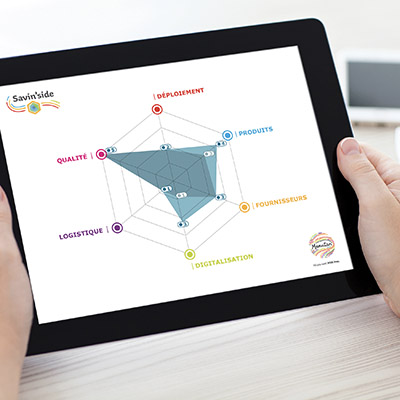
To support organisations in optimising their non-production procurement, Manutan created the Savin’side® method. Drawing on data analysis, a Lean framework and an agile approach, this method aims to boost organisations’ competitiveness.
It is structured around three main stages:
- Spend audit
Our procurement consultants analyse the company’s spend and purchasing behaviour to identify the main optimisation levers: supplier rationalisation, transaction digitalisation, and more. The data is then benchmarked against market references.
- Tailored action plan
Together with the lead buyer, they co-build a tailored improvement plan. Clear objectives, performance indicators and a rollout timetable are defined to steer results.
- Steering and continuous improvement
Together, they set up a monitoring system, in the form of quarterly reporting, to measure the gains achieved and adjust actions if needed. This continuous improvement approach helps embed practices for the long term.
Non-production procurement therefore sits at the heart of companies’ competitiveness challenges. Its volume, the multiplicity of suppliers and the risks linked to maverick spend highlight its strategic dimension for procurement departments. The key challenge is to bring it under control in order to reduce costs, while improving efficiency and visibility.
[1]Aurélie WENDLING (Key Account Manager Europe 2022-2024, Manutan), Webinar: Long tail, indirect and maverick spend... understanding them better to optimise them, 17 January 2023, 30 min, Manutan
[2]Manutan Group, internal data
[3]Manutan Group, internal data
[4]The Hackett Group, User Experience and Maverick Spend Study, 2018