

Inflation is reshaping the economic balance of businesses: cost prices under pressure, procurement budgets destabilised, and profit margins eroding. To respond, the procurement department has concrete levers at its disposal, from risk mapping to rationalising indirect procurement spend. This article offers a strategic and operational overview for turning the inflationary squeeze into a lever for lasting performance, and taking back control of costs.
Contents
- What is the impact of inflation on the profitability of businesses?
- Why is the procurement department the first line of defence against inflation?
- How can you identify and prioritise the spend categories most exposed to inflation?
- 3 concrete procurement levers to absorb rising costs without sacrificing quality
- Optimising indirect procurement: the most underused savings opportunity during inflation
- The Manutan approach: how Savin'Side® helps businesses protect their profit margins for the long term
The rise of inflation in recent years has reminded businesses of an often-underestimated reality: cost control cannot be improvised in a time of crisis. Between rising raw material prices, pressure on energy and unstable prices for goods and services, margins erode rapidly when procurement isn't managed in a structured way. Meeting these challenges calls for clear strategies: mapping expenditures, tracking cost increases, and building the resilience every business and every company needs for the future. Rethinking your procurement processes is no longer an option: it's a strategic necessity.
Higher interest rates have increased the cost of bank credit, squeezing both cash flow and consumer income, while pressure on spending adds further complexity to this economic backdrop. As interest rates and the base rate continue to move, price increases become harder to predict. Fluctuating exchange rates and ongoing supply chain disruptions make sourcing internationally even harder for companies. If left unmanaged, higher inflation can quickly erode profit margins, and it can also force businesses into repeated, costly renegotiations with suppliers.
What is the impact of inflation on the profitability of businesses?
How inflation can affect businesses varies significantly from one sector to another. Inflation isn't limited to a one-off rise in prices. It takes hold as a structural phenomenon that runs through every sector, weighing on both production costs and businesses' ability to forecast.
In economic terms, inflation reflects a sustained rise in the general price level of goods and services, measured by the consumer price index. When the inflation rate rises, businesses see their cost prices increase, while their selling prices can't always keep pace, at the risk of losing market share.
Milder inflation, but certain cost categories remain under pressure
While overall inflation has eased, businesses still face very mixed cost trends depending on the category and sector. In July 2026, annual inflation in the eurozone was estimated at 2.9%, after 2.8% in June. Behind this average, the gaps remain significant: energy prices showed an estimated annual rise of 10%, compared with 3.3% for services and 0.9% for non-energy industrial goods.
In the UK, the Office for National Statistics tracks these movements closely through its Consumer Prices Index, giving businesses a clearer read on where price pressures persist.
For businesses heavily exposed to energy, transport, raw materials or certain services, cost pressure can therefore remain significant despite the slowdown in overall inflation. In this context, procurement teams have every interest in keeping close watch on their main expenditure categories and retaining levers to anticipate price changes. This pattern holds true across companies of every size.
Squeezed margins and destabilised procurement budgets: the direct effects of inflation on profitability
When increases in supplier prices can't be passed on in full to the selling price, cost prices absorb the difference. Margins contract, cash flow tightens and running the business becomes more complex, with the effects ultimately showing up on the income statement. This mechanism turns rising prices into a major financial risk: the business pays more cash to source what it needs, without being able to offset the increase by an equal amount.
What happens if inflation rises persistently for a business?
Persistent inflation sets off a spiral that's hard to stop: repeated supplier renegotiations, the gradual de-indexing of product prices, and pressure on growth and competitiveness. Some sectors, more exposed to commodity price swings, feel amplified effects. Faced with this scenario, structuring a long-term procurement response becomes a matter of resilience for any organisation.
Why is the procurement department the first line of defence against inflation?
While inflation is imposed from outside, the response is built from within. Procurement management, when rigorous and well structured, is the most direct lever for limiting the impact of rising costs on the business's income statement and overall results. This is why finance and procurement teams increasingly need to work hand in hand to weather an inflationary economy. With interest rates staying high and finance teams under pressure to protect cash flow, investment plans and growth targets alike are being reassessed across every part of the business.
From negotiation to strategic management: the evolving role of the Procurement Manager
In an inflationary economy, the Procurement Manager can no longer simply manage unit prices. Their role is evolving towards a broader view that takes in supply resilience, supplier risk management and long-term economic performance. This growing need for strategic skills is now expected across all major sectors of activity.
How procurement performance protects profit margins and supports growth
Well-structured procurement helps contain the impact of rising costs on cost prices and preserve a business's capacity for investment. Effective procurement isn't simply a cost centre: it's a direct lever of value that supports growth and strengthens competitive position over time.
How can you identify and prioritise the spend categories most exposed to inflation?
You can only act effectively on what you measure. Mapping expenditures is an essential first step for any strategy against inflation.
Direct procurement vs indirect procurement: which categories are the most vulnerable?
Direct procurement (raw materials, components) is often first affected during a period of rising prices. Yet indirect procurement (supplies, maintenance, internal logistics) carries budget overrun risks that are just as significant. Less well managed and more fragmented, it provides fertile ground for cost creep during periods of inflation.
Beyond unit price: adopting a TCO approach to measure the true cost of a purchase
Total Cost of Ownership[1] (TCO) goes well beyond the listed purchase price, factoring in hidden costs: administrative overheads, quality issues, having too many suppliers, and order-processing charges. This approach uncovers savings opportunities that a conventional analysis simply doesn't see.
In an inflationary context, two indicators deserve particular attention: the contract coverage rate and the level of concentration within the supplier panel. The first identifies the share of expenditures where prices and purchasing terms are set out in a contract, making it easier to measure the business's exposure to price changes. The second highlights both the fragmentation of procurement across many suppliers, a potential source of extra management costs, and any dependency on a limited number of partners. Tracking them helps the procurement department better target risks and prioritise its actions on negotiation, rationalisation or supply security.
3 concrete procurement levers to absorb rising costs without sacrificing quality
The goal isn't simply to endure the inflationary squeeze, but to turn it into an opportunity for lasting structure. Three actionable levers stand out for their immediate effectiveness and their long-term reach.
Lever 1: Structuring pricing terms through framework agreements to gain visibility
Clear, well-defined pricing terms are essential for protecting margins, especially while interest rates and raw material costs remain volatile. Framework agreements make it easier to control changes in pricing terms and improve budget visibility, particularly when price revision mechanisms, their frequency and their conditions are clearly defined. While they don't remove exposure to rising costs, they give businesses a more predictable framework for anticipating price changes, securing negotiated terms and making budgets easier to manage, freeing up money and cash for other priorities. They can also help reduce risk and strengthen negotiating power by giving greater visibility over future volumes and needs.
Lever 2: Rationalising product ranges and consolidating the supplier panel to strengthen negotiating power
A scattered supplier panel dilutes negotiating power and multiplies management costs. By consolidating suppliers and rationalising product ranges, a business secures better pricing terms, simplifies its internal processes and strengthens its resilience against any fresh rise in costs, helping businesses of every size protect long-term growth. Fewer, better-selected suppliers also means fewer operational risks.
Lever 3: Digitalising indirect procurement to eliminate hidden costs and automate recurring orders
Digitalising indirect procurement, using e-procurement tools, can help reduce the cost of processing each transaction significantly, saving both time and money while freeing up cash for other priorities. Aurélie Wendling, European Key Account Manager at Manutan, puts a precise figure on it: “When a transaction is fully digitalised (with a punch-out[2] system in place, along with the dematerialisation of orders and invoices via EDI), its cost is estimated at 19 euros. This brings the cost down from 95 euros to 19 euros, a saving of up to 76 euros per transaction.”[3]
In an inflationary context, these savings on operational costs take on considerable strategic value over time.
Optimising indirect procurement: the most underused savings opportunity during inflation
Many businesses underestimate just how much indirect procurement is costing them. It is often the least well managed area of the business: fragmented and poorly controlled, it nonetheless harbours hidden costs that directly amplify the impact of inflation on budget management, spending patterns and overall cash flow.
Why does indirect procurement carry so many hidden costs?
Too many separate orders, off-catalogue purchases, over-specified products and non-compliant processes: these issues all inflate the total cost of ownership well beyond the listed price. During periods of high inflation, these problems pile up on top of the general rise in prices and weaken the business's financial position even further.
Reducing without compromising: how to balance cost savings against service quality
Reducing indirect procurement mustn't come at the cost of working conditions or the organisation's reputation. Concrete criteria can help strike the right balance:
- Making sure products are genuinely suited to employees' real needs;
- Using private label products for comparable quality at a lower cost;
- Considered sourcing within a stable scope, without any loss of operational performance.
Optimisation, then, isn't about buying at the lowest price at any cost, but about getting the best value for money at the level of quality that's genuinely needed, for the best overall cost.
The Manutan approach: how Savin'Side® helps businesses protect their profit margins for the long term
Every business faces different challenges, and no single set of strategies fits every company, but these three levers apply across the board. They only deliver their full effect, however, when backed by a strong partner capable of supporting the approach over the long term, for businesses of every size. This is the thinking behind the Manutan approach.
Savin'Side®: identifying, measuring and reducing the hidden costs of indirect procurement
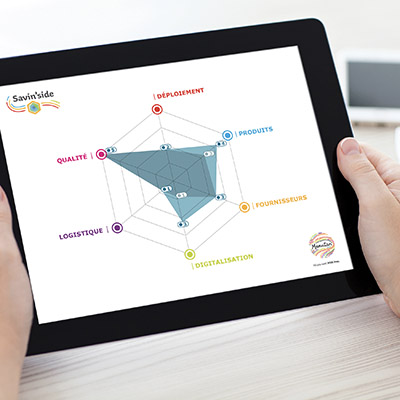
Savin'Side® is an indirect procurement optimisation programme from Manutan. It's built on an in-depth assessment of hidden costs, the identification of high-spend areas and rationalisation recommendations tailored to each organisation. In an inflationary context, having a precise read on indirect expenditures becomes a decisive economic advantage for managing savings over the long term.
Manutan framework agreements: price stability and long-term supply security
Manutan framework agreements offer long-term price visibility, protecting procurement budgets against short-term spikes and helping finance teams plan cash flow and future growth with greater confidence. They also simplify the administrative management of recurring orders, a key issue for procurement teams under pressure. The contract coverage rate improves, processes become smoother, and running the business becomes far less stressful in the face of inflation.
Procurement integration & optimisation with Manutan
Manutan handles integrations with your existing tools (ERP, e-procurement platforms) and offers Savin'Side®, its indirect procurement optimisation programme. A fast connection, dedicated training and ongoing support make it possible to streamline recurring orders, reduce processing costs and manage savings over the long term. Available in Belgium, the Czech Republic, Denmark, Sweden, Finland, France, Germany, Hungary, Italy, the Netherlands, Norway, Poland, Slovakia, Spain, Switzerland, the United Kingdom and Portugal, at the time of publication of this content.
[1] Total Cost of Ownership (TCO): the total cost of ownership, taking into account all the expenditures associated with acquiring and using a good or service throughout its entire life cycle.
[2] Punch out: an integration protocol that allows a buyer to access a supplier's catalogue directly from their own information system, without manually re-entering data.
[3] Aurélie WENDLING (European Key Account Manager 2022-2024, Manutan), 17 January 2023, Webinar: Achats de classe C, indirects, sauvages… mieux les appréhender pour les optimiser, Manutan.