


As the procurement function becomes increasingly strategic in companies, it is essential to measure the maturity, effectiveness and performance of procurement. This is the objective of the procurement audit: a structured tool that enables your team to assess and improve the procurement function. It allows you to take stock of your current situation, compare yourself and commit to a continuous improvement approach. Any type of company can carry out a procurement audit, from start-ups to large enterprises, with different objectives. It is through this procurement auditing process that one can consider moving from a support function focused on operations to a strategic function that creates value.
What is a procurement audit?
A procurement audit involves analysing a company's procurement function in a structured and in-depth manner. The objective is to assess strengths and weaknesses, areas for improvement and value creation levers.
Procurement audits provide a clear view of the maturity of the procurement function and help build a roadmap. This helps companies base their procurement on an impartial assessment and on the best practices in the sector. According to Efficio, a procurement and supply chain consultancy, this exercise offers a potential for savings ranging from 5 to 15% per procurement category.
"The audit remains essential, but it must evolve to meet the new realities of the procurement function. It is no longer simply a comparative benchmark, but an in-depth internal audit that identifies strengths, weaknesses and solutions specific to the company. The audit must also enable a consensus to be established on the collective ambition of the procurement function and to define a roadmap shared with other functions to secure acquisitions, control costs and contribute to value creation." Jean-Dominique Rey, Founding Partner of 15-40 Partners.[1]
The main areas of a procurement audit
Although there is no standard framework, there are different models to rely on. Generally, the procurement audit covers several dimensions, ranging from strategy to expenditure management. The idea is to carry out a comprehensive audit, which covers qualitative, quantitative and evolutionary dimensions.
Strategy and governance
This area ensures that the procurement function is properly aligned with the company's strategy and has decision-making power. We examine the role of the Chief Procurement Officer within the management committee, procurement policy and strategy...
Organisation and team skills
The procurement audit also involves aligning ambitions with human resources. This concerns team size, everyone's roles and responsibilities, training plans...
Processes and methods
The idea here is to improve the reliability of procurement processes: source-to-pay, supplier management, contract management...
Tools and information systems used
As part of the procurement audit, it is also necessary to examine the tools and information systems used by the procurement team. This involves analysing the quality of repositories, the depth of historical data, access rights...
Risk management and compliance
The audit must therefore also include a detailed analysis of supplier risks, supply chain vulnerability and regulatory compliance.
Spend analysis
Spend analysis is essential to any procurement audit process. This aims to understand precisely how and where spending is carried out. We assess in particular the distribution and weight of procurement according to different perspectives, waste and opportunities for improvement.
Sustainable procurement
Lastly, a procurement audit can no longer ignore the CSR dimension (Corporate Social Responsibility). The assessment must therefore focus on the presence of clauses in contracts and tenders, monitoring the carbon footprint of procurement and CSR audits at suppliers.
The long tail spend audit
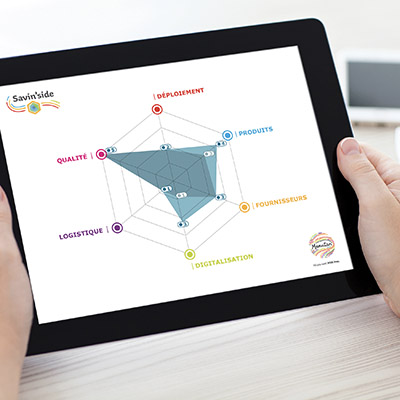
The Manutan Group has developed an audit specifically dedicated to long tail spend. These procurement categories, often considered non-strategic, suffer from unstructured management and contain significant hidden costs.
This audit, called Savin'side®, is based on a proven method with hundreds of large companies. The principle: scrutinise six major areas for improvement to boost the economic and environmental performance of long tail spend. Among the main optimisation areas, we find, for example, supplier rationalisation, digitalisation of transactions and the deployment of agreements.
- Discover Savin'side® (https://www.manutan.com/savinside/en/discover-savinside)
The 5 key stages of the procurement audit
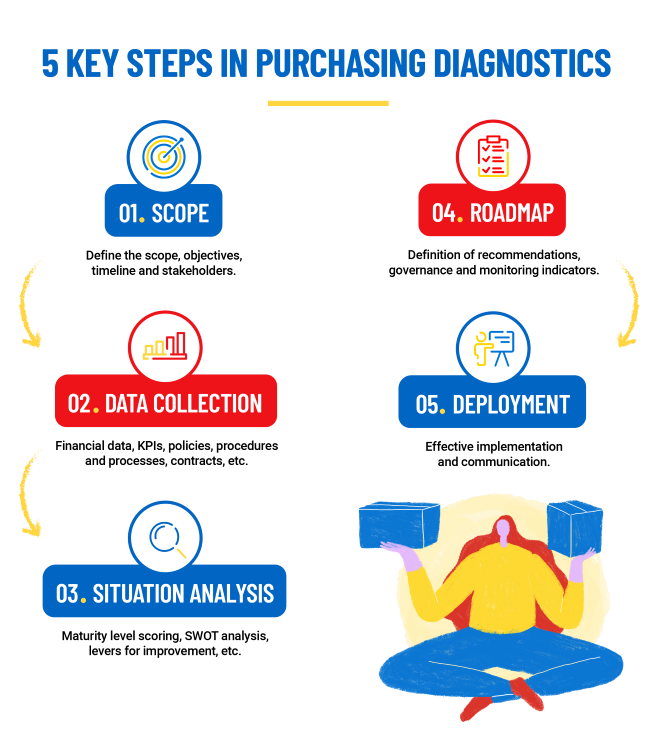
The procurement audit is based on five main stages, from project scoping to the implementation of the action plan.
5 key steps in purchasing diagnostics
Stage 1: Scoping
The first stage of a procurement audit is to scope the project. Before launching, it is advisable to define the scope, objectives, schedule and stakeholders to involve.
Stage 2: Data collection
The procurement audit is based on a factual database. To carry out the assessment, the company will collect different types of data: financial data, performance indicators, policies, procedures and processes, current contracts... These elements will be supplemented by qualitative interviews with procurement teams and internal stakeholders.
Stage 3: Situation analysis
Once the data has been collected, it's time for the analysis phase. This leads to a scoring of the procurement maturity level by area, risk mapping, opportunities, strengths and weaknesses, improvement levers with "quick wins" and more structural actions.
Stage 4: Roadmap
Based on these findings, it is a question of building your roadmap. This must remain focused on the value brought to the company, but also the profitability for the procurement function. Recommendations should be prioritised according to the benefit/effort ratio. Without forgetting to define governance and monitoring indicators.
Stage 5: Deployment
Lastly, it is about implementing the roadmap, with a dashboard to ensure management. Communication plays a key role in this deployment phase. It may be necessary to share the results of the procurement audit with stakeholders: internal customers, management controller, human resources manager... Their support can prove invaluable in successfully carrying out your transformation plan.
The procurement audit thus offers an objective view of procurement, but also a structured framework for continuous improvement. It is with such a tool that the procurement function will be able to build its transformation plan and meet tomorrow's challenges.
[1] Jean-Dominique, REY, (Founding Partner, 15-40 Partners), Le diagnostic de la fonction Achats : un outil toujours pertinent mais sous une forme renouvelée, LinkedIn, 9 septembre 2024, [https://www.linkedin.com/pulse/le-diagnostic-de-la-fonction-achats-un-outil-toujours-rey-myp6e/?trackingId=jUu%2BUl4tORMybkO3A5P8XA%3D%3D]