


Intake management, or intake-to-procure, is emerging as a dual-value procurement governance lever that eliminates off-contract spend, structures the procure-to-pay cycle and produces actionable KPIs. It is also a mechanism for controlling financial and regulatory risk in a demanding European context. This article guides you on how to centralise purchase requests, secure compliance and optimise the requester's experience through a single point of entry, in conjunction with existing procurement resources.
Contents:
- Intake management: what does it actually mean?
- Why does off-contract spend cost your company so much?
- How does intake management orchestrate every stage of your procure-to-pay cycle?
- Intake management and corporate governance: a strategic lever for the Managing Director
- Which KPIs measure the ROI of your intake management?
- How does Manutan support your intake management approach?
The indirect procurement process often suffers from structural fragmentation: requests arrive through multiple channels, negotiated contracts are bypassed, and traceability is lacking. This scattering exposes companies to growing financial and regulatory risks. Intake management is emerging as a structural response to this reality, centralising requests before they enter the procurement cycle. An operational issue for the procurement department, a governance issue for senior management: the two dimensions are inseparable.
Intake management: what does it actually mean?
Intake management refers to the process of centralising and qualifying purchase requests before they are processed within the procure-to-pay cycle. It is the single point of entry through which every request is received, assessed and routed. Understanding this concept matters, as procurement departments across Europe are increasingly structuring this stage of the purchasing process.
What does 'intake' mean in the context of professional procurement?
In the context of professional procurement, intake refers to the reception and qualification phase for every request before it is processed. This term has become established across European procurement teams to describe a structured mechanism for admitting needs, distinct from a simple purchase order. Formalising request management in this way ensures that every need is assessed against consistent criteria before entering the supply chain.
Intake management vs. a simple purchase request form: what's the real difference?
A purchase request form collects information. The intake-to-procure process, on the other hand, orchestrates the qualification of the need: purchase category, listed supplier, budget envelope, required approval level. It integrates with existing P2P tools and automates approval workflows. For indirect procurement (MRO, office supplies, warehouse equipment), this governance prevents one-off orders that bypass negotiated contracts.
Why does off-contract spend cost your company so much?
The absence of intake management paves the way for a gradual drift in indirect spend. Operational staff, faced with processes they see as too heavy, bypass established channels. Spend management suffers directly as a result.
Maverick spend: when untracked purchases undermine your savings
Maverick spend refers to purchases made outside the channels and contracts approved by the procurement department. It thrives wherever processes are seen as too complex. As Aurélie WENDLING, then European Key Account Manager at Manutan, points out: “Procurement and supply processes can be deficient and undermine operational efficiency. The other risk is that they become so complex, outdated or time-consuming that, over time, internal customers start to bypass them. This is how maverick spend develops, a real scourge for procurement departments.”[1]
This phenomenon mainly affects long tail spend : low unit value, high frequency, and many requesters. The cumulative impact on contractual savings is nonetheless significant.
Regulatory and reputational risks: what a lack of traceability exposes you to
Beyond lost savings, a lack of supplier traceability exposes companies to growing regulatory risks. The European CSDDD directive on corporate sustainability due diligence and the CSRD require companies to document their supply chains and demonstrate their social and environmental compliance. In the UK, the Modern Slavery Act requires similar commitments; in Norway, the Transparency Act requires the publication of due diligence assessments; in Switzerland, the federal duty of care law applies to listed companies. Third-party risk management is thus becoming an enforceable requirement, not simply an internal tool. An intake management system produces an audit trail for every request, every supplier engaged and every budget approval.
How does intake management orchestrate every stage of your procure-to-pay cycle?
Intake-to-procure doesn't replace procure-to-pay: it acts as its entry portal, qualifying every need before the formal cycle begins.
From expressing a need to placing an order: where's the line between intake management and procure-to-pay?
Intake management is often confused with procure-to-pay, even though the two cover distinct scopes. The intake process handles the upstream phase: expressing the need, qualifying the category, selecting the listed supplier, and budget approvals. The definition of procure-to-pay, meanwhile, situates the formal cycle from the point of the validated order onwards. Intake-to-procure is therefore the transition phase between the need expressed and the order placed. This clearly defined boundary reduces processing times and removes downstream requalification steps.
Integration with your supplier catalogues and existing P2P tools
Effective intake management connects with ERP systems, e-procurement solutions and listed supplier catalogues through standardised connectors (EDI, punch-out[2]). This single point of entry covers every indirect procurement category, including MRO and professional supplies, ensuring adoption by operational teams. The features of a P2P solution are then fully activated, with no break in the processing workflow.
Intake management and corporate governance: a strategic lever for the Managing Director
Intake management goes beyond the technical remit of procurement teams. It is an internal control mechanism that directly concerns senior management, both in terms of risk management and financial oversight.
Regulatory compliance: how intake management protects your company
Every request processed in an intake platform generates a time-stamped record: supplier engaged, justification for the need, approver, amount committed. This documentation meets the requirements of the CSDDD and the CSRD regarding supply chain transparency. It also covers the obligations imposed by the UK's Modern Slavery Act and Norway's Transparency Act. Third-party risk management draws on this data to assess suppliers systematically. Contract management is strengthened as a result: every commitment is backed by a qualified, validated request that can be relied upon in the event of an audit.
Real-time spend visibility: a management tool for senior leadership
Structured intake management consolidates all indirect spend into a single, unified dashboard. Senior management therefore gets an aggregated view of commitments, by entity, by category and by supplier. Budget overruns are spotted before they materialise. This visibility ties in naturally with accounts payable automation, reducing month-end closing times and improving the reliability of financial reporting.
Which KPIs measure the ROI of your intake management?
Rolling out intake management without performance indicators is like driving without a dashboard. A consistent set of metrics helps demonstrate the value of the system and ensure its continuous improvement.
Contract compliance rate, cycle time, maverick spend: the key metrics and adoption on the ground
The essential KPIs for procurement are as follows:
- Contract compliance rate: the proportion of purchases made through listed suppliers;
- Share of maverick spend in total purchasing: a drift indicator to monitor monthly;
- Average request processing time (cycle time): a measure of the operational efficiency of the intake process;
- Tool adoption rate among requesters: a direct reflection of the user experience on offer;
- Rejection rate for non-compliant requests: an indicator of the maturity of the upstream process;
- Savings achieved vs baseline: tangible proof of ROI for senior management.
The experience of operational users determines whether the system is genuinely adopted. Complex intake management will be bypassed, however technically robust it is. Specialist vendors assessed in Gartner's magic quadrant[3] now factor this dimension in as a differentiating criterion.
How does Manutan support your intake management approach?
Manutan doesn't position itself solely as a product supplier: we support organisations in their indirect procurement orchestration, from digitalising processes through to integration with existing P2P environments.
Savin'side: Manutan's solution for managing your indirect procurement end to end
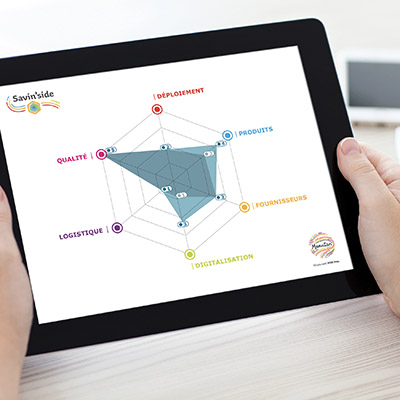
Savin'side centralises requests, ensures negotiated contracts are applied and reduces maverick spend on indirect procurement. The solution covers the MRO, office supplies and warehouse equipment categories, with native compatibility with SAP Ariba[4] intake environments. It forms part of the drive to digitalise procurement processes across Europe, where procurement workflows automation becomes a measured and documented performance lever. Ariba intake management is therefore supported natively, with no bespoke development required.
Integration & eProc with Manutan
Manutan supports ERP and e-procurement integrations (EDI, punch-out, PunchOut2Go, SAP Ariba) with a fast connection, dedicated training and ongoing support. Savin'side lets you connect the Manutan catalogue directly to your P2P environment to eliminate off-contract orders on indirect procurement. Available in Belgium, Czech Republic, Denmark, Sweden, Finland, France, Germany, Hungary, Italy, the Netherlands, Norway, Poland, Slovakia, Spain, Switzerland, the United Kingdom and Portugal, as of the publication date of this content.
Interfacing with your ERP and P2P systems: seamless integration
Manutan's standardised connectors interface with the leading ERP systems (SAP, Oracle) and e-procurement platforms. Once a request is validated in the intake tool, it automatically generates the purchase order, the goods receipt and the paperless invoice. The economic benefit of this integration is well documented: as Aurélie WENDLING, European Key Account Manager at Manutan, explains, full digitalisation transforms the cost structure per transaction: “When this process is carried out in the traditional way, costs amount to an average of 95 euros[5] per transaction. On the other hand, when a transaction is fully digitalised – that is, with the implementation of a punch-out and the dematerialisation of orders and invoices via EDI – the cost per transaction is estimated at 19 euros[6]. This therefore represents up to 76 euros[7] in savings per transaction.” [8]
[1] Aurélie WENDLING (European Key Account Manager 2022-2024, Manutan), 17 January 2023, Webinar: Long tail, indirect and maverick spend... understanding them better to optimise them, Manutan.
[2] Punch-out: an integration protocol that lets a buyer access a supplier's catalogue directly from their ERP or e-procurement platform, while maintaining order traceability.
[3] Magic quadrant: a Gartner analysis model positioning software vendors according to their completeness of vision and ability to execute.
[4] SAP Ariba: a procurement and supply chain management platform published by SAP, widely adopted by large European organisations for procurement intake management.
[5] Around £81
[6] Around £16
[7] Around £65
[8] Aurélie WENDLING (European Key Account Manager 2022-2024, Manutan), 17 January 2023, Webinar: Long tail, indirect and maverick spend... understanding them better to optimise them, Manutan.