The circular economy, a driver of transformation for the Manutan Group
Driven by its ambition to do business for a better world, the Manutan Group aims to contribute to a more responsible model that combines performance, sustainability and ethics. To achieve this, we are making the circular economy one of the pillars of our business model. We are convinced it is the most relevant way to reconcile economic and sustainable development, thereby creating a virtuous circle that generates value for our entire ecosystem. Today, we are accelerating our initiatives and setting ourselves ambitious targets.
The circular economy: a response to shared challenges
We firmly believe in the potential of the circular economy. By rethinking our modes of production and consumption, this model offers tangible solutions to major economic, environmental and social challenges.
A lever for competitiveness
The circular economy represents an economically attractive alternative. By choosing refurbished equipment or circular services, organisations benefit from lower-cost solutions without compromising on quality. For example, our refurbished products are on average 30% cheaper than new ones. They are also subject to strict quality controls and come with robust guarantees. We are, moreover, the first organisation to be audited by FCBA under the “Verified by” programme for the refurbishment of our office seating, achieving the “Advanced” level.
A driver of decarbonisation
Extending the lifespan of products is a major lever for reducing greenhouse gas emissions. It is important to note that a significant share of the carbon footprint of equipment is generated during its manufacture. At Manutan, we estimate that a refurbished product avoids, on average, 80% of carbon emissions compared with a new equivalent. This enables organisations to reduce their Scope 3 emissions, which often represent the bulk of their carbon footprint.
A guarantee of resilience for our value chains
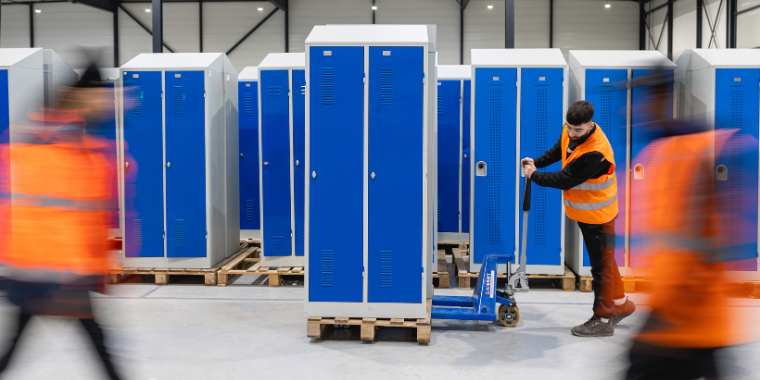
In a context of increasingly scarce raw materials and growing pressure on supply chains, the circular economy provides a resilient model. This is why we have created our own Circular Hub dedicated to the reuse of furniture, supported by the Île-de-France Region. By prioritising local sourcing and revalorisation, we reduce dependence on certain resources, strengthen our industrial sectors and secure our value chains.
Tangible social and regional impact
Circularity generates positive externalities for local areas: job creation, skills development, partnerships with social inclusion organisations, and more. By supporting these ecosystems, we help stimulate local economic life. Within our Circular Hub, we have also developed a professional integration activity in partnership with ARÈS and Valdelia. The circular economy thus becomes a driver of social cohesion and regional development.
Essential regulatory compliance
This model also meets increasing regulatory requirements: the Anti-Waste for a Circular Economy (AGEC) law and the Climate and Resilience law in France, as well as the new Ecodesign for Sustainable Products Regulation and the right to repair at European Union level. Circular solutions are fully aligned with these new regulations, which aim to encourage more sustainable consumption patterns. Within our Public Sector Division, we provide AGEC reports to help our clients complete their annual declarations.
Our circular ambition
For all these reasons, we aim to make the circular economy a cornerstone of our development strategy. Today, we offer a broad circular range for businesses and public sector organisations across the European market.
This includes:
- Refurbished products sourced from our own Circular Hub or from specialised suppliers. To date, we cover a wide range of products, from professional furniture to storage and handling equipment, as well as games and toys.
- Circular services such as the collection and revalorisation of used equipment, as well as equipment rental and repair. These turnkey solutions optimise product life cycles.
Looking ahead, our ambition is to accelerate this momentum. All these solutions are continuously improved, expanded and rolled out across our various subsidiaries. At the same time, we have begun supporting strategic clients in their procurement decarbonisation plans, leveraging this circular offering.
By 2035, we have set ourselves a clear target: to increase the share of our circular offering to 10% of our total revenue. An ambitious goal that drives us forward with determination.
As a committed distributor, we aim to play an active role in this circular transition. That is why we are dedicated to developing concrete solutions while promoting a more sustainable economic model.